The WNBA is in its 30th season, a milestone that should invite reflection on just how far the league has come since its inaugural season in 1997. But as the league celebrates three decades of existence, it is also navigating a period unlike anything it has experienced before. The latest controversy involving Chicago Sky guard DiJonai Carrington and Indiana Fever guard Sophie Cunningham is about much more than one foul. During Saturday’s game between Chicago and Indiana, Carrington was assessed a Flagrant 2 and ejected after a hard foul on Cunningham. After the ejection, Carrington posted “WHITE PRIVILEGE” and tagged the Indiana Fever on Threads, immediately pushing the conversation beyond basketball and into the larger cultural debates that have increasingly surrounded the WNBA.
The reaction has produced another round of arguments about race, officiating, physicality and whether certain players are treated differently. It has also brought previous incidents back into the conversation, Caitlin Clark’s foul on Jordin Canada in 2024, and the 2025 confrontation between Cunningham and Jacy Sheldon. But perhaps the bigger question is not whether the WNBA has too much controversy. Perhaps it is whether we are witnessing what happens when a professional sports league experiences unprecedented growth while being watched under a microscope that did not exist for previous generations of athletes.
The WNBA is growing up in public.
And that distinction matters.
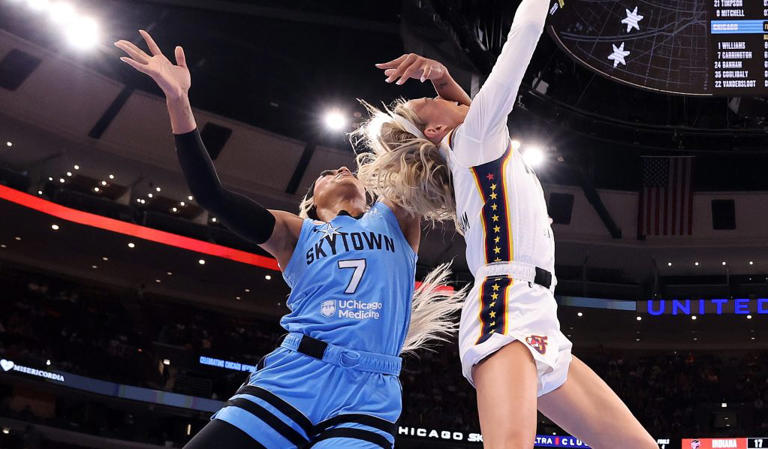
(Photo by Michael Reaves/Getty Images)
Thirty years into its existence, the league is no longer operating on the periphery of the American sports landscape. The WNBA has entered a new era of visibility, and with that visibility comes scrutiny. In 2024, the league recorded its most-watched regular season in 24 years, its highest total attendance in 22 years and records for merchandise sales and digital consumption. The league generated nearly two billion social-media video views, more than four times its previous total.
The growth has continued. The WNBA has expanded its footprint, added new markets and continued to see unprecedented demand for its product. More people are watching, more people are talking and, inevitably, more people are looking for the next controversy. That last part is important because the WNBA is not the first professional sports league to experience growing pains. We simply have a tendency to forget them.
Before the NBA became the global basketball powerhouse it is today, the league went through some extremely difficult periods. The NBA dealt with drug problems, declining attendance, concerns about player behavior and violent incidents that shocked the sport. One of the most infamous examples came during the 1977-78 season, when Lakers forward Kermit Washington punched Houston Rockets forward Rudy Tomjanovich during a fight. Tomjanovich suffered massive injuries to his jaw, eye and cheek, and the incident became one of the darkest moments in NBA history.
The NBA also had a significant drug problem during the 1970s. When David Stern became commissioner in 1984, he inherited a league dealing with serious image problems. Stern’s tenure would eventually become associated with efforts to address those issues, including drug testing, changes to the league’s business structure and a broader effort to improve the NBA’s image. At the same time, the league benefited from the emergence of stars such as Magic Johnson, Larry Bird and Michael Jordan, who helped transform basketball’s popularity in the United States and eventually around the world.
It is easy to look at the NBA today and forget those years. We remember Magic and Bird. We remember Michael Jordan. We remember the explosion of basketball’s popularity in the 1980s and 1990s and the transformation of the NBA into a global sports brand. But the NBA did not skip the messy part. It had to go through it.
Neither did Major League Baseball.
Baseball’s steroid era arrived during one of the sport’s most commercially powerful periods. Mark McGwire and Sammy Sosa captivated the country during their historic 1998 home-run chase. Barry Bonds later broke the single-season home-run record while questions surrounding performance-enhancing drugs and the BALCO investigation followed him. Baseball eventually had to confront the consequences of that era, including congressional hearings and years of debate over performance-enhancing drugs. Yet that period did not mean baseball was suddenly irrelevant. In many ways, it occurred while the sport was enjoying enormous attention.
The important point is not that controversy made the NBA or MLB successful. It didn’t. The point is that growth and problems can exist at the same time. A league can attract new fans, generating unprecedented interest and become more commercially valuable while simultaneously dealing with serious issues that require attention.
The WNBA is experiencing that reality now, but there is one major difference: the WNBA is doing it in the social-media era.
When the NBA was dealing with some of its most serious problems, there was no X, Instagram, TikTok or Threads allowing players, fans and media members to react within seconds. There was no ability for a single post from a player to become a headline before the game had even ended. Today, every hard foul can become a video clip. Every disagreement can become a debate. Every social-media post can become a national story, and every controversial incident can be pulled back into the history of previous incidents involving the same players.
We have seen that happen repeatedly in the WNBA. In 2024, Clark went for a block on Atlanta Dream guard Jordin Canada, missed the ball and contacted Canada’s head during a fast-break play. Clark was assessed as a common personal foul. That play was subsequently compared by fans and commentators as part of a broader debate about whether similar contact involving different players was being officiated consistently.
Then, in 2025, Cunningham became part of a physicality controversy when she delivered a hard foul on Connecticut Sun guard Jacy Sheldon late in a game. Sheldon confronted Cunningham after the play, the situation escalated and both players were ejected. Cunningham was later fined. That incident became another example of the WNBA’s increasingly visible conversations about physicality, retaliation and player discipline.
Now Cunningham is again at the center of a physicality debate, this time involving Carrington. Almost immediately, those earlier incidents resurfaced. That is what makes the current controversy bigger than the foul itself. The individual plays are not necessarily identical, and they should not be treated as though they are. But each has become part of the WNBA’s larger argument about physicality, officiating and consistency.
That is also where the conversation becomes complicated. Carrington has every right to be frustrated with a call, and WNBA players have every right to use their platforms and speak about issues they care about. But accusing an opponent or the league of “white privilege” in response to a basketball ruling takes the conversation into an entirely different place. If race influenced an officiating decision, that would be a serious allegation that deserves to be examined. But it should be supported by evidence rather than assumed because the players involved are of different races. Otherwise, a conversation that could have been about officiating, physicality and player safety becomes another racial and political battle.
At the same time, the league cannot simply dismiss why these conversations continue. When fans see different outcomes from physical plays, they are going to ask questions about consistency. When a hard foul leads to one punishment and another seemingly similar play produces something different, the league has to be able to explain those differences. The WNBA has to address legitimate questions about officiating consistency, player safety, discipline, physicality and how controversial situations are handled. Players also have a responsibility to understand that their platforms carry more weight now because the league carries more weight.
That is the price of becoming more visible.
The WNBA spent decades trying to convince people to pay attention. Now everyone is paying attention. That means the league gets the benefits of unprecedented growth: larger audiences, bigger stages, greater media coverage, expanded merchandise sales and increased cultural relevance. But it also gets the uncomfortable part. The mistakes are visible. The disagreements are visible. The players’ reactions are visible. The league’s response is visible. Sometimes, the controversy is visible before the league even has time to respond.
Perhaps that is the real transition happening in women’s basketball. The WNBA’s growing pains are not proof that the league is failing, just as the NBA’s problems in the 1970s and 1980s did not mean basketball was destined to fail. Baseball’s steroid era did not erase the sport’s place in American culture either. Those leagues had to confront their problems while simultaneously capitalizing on periods of enormous growth.
The WNBA is now being asked to do the same thing, only with an audience that can document, debate and amplify virtually everything in real time.
The answer is not to pretend the problems do not exist. It is also not to treat every controversy as evidence that the league is broken. The league has to acknowledge its problems, establish consistency, hold people accountable and continue building an environment where players can compete without every physical confrontation becoming a referendum on race, politics or the future of the sport.
The WNBA is growing up.
And for the first time in its history, it is doing so with millions of people watching every step.
Discover more from KB Sports Media
Subscribe to get the latest posts sent to your email.